PDF guide
French Riviera and Corsica Boating Logbook: Anchorages, Protected Areas, Winds and Harbours
Area by area, from Menton to Porto-Vecchio: the anchoring rules actually in force, the winds, the VHF forecasts, the harbours and day trips.
What you get for €29
12 chapters, 28 A4 pages, over 5,500 words. A PDF to download and print, and the same content online, readable on a phone. One payment, instant access, confirmation email.
Buy · €29Secure payment by StripeApple PayGoogle PayInstant PDF + online access
Or all 5 guides and the logbook in The Skipper’s Pack: €69. Sold separately: €135.
You pay → instant access to the guide and the PDF + email → findable at any time (Find my purchases). Questions: admin@tech-bharat.com
Who it is for
- You are hiring a boat for a day or a week between Menton and Marseille, or in Corsica, and you want to know where you are actually allowed to drop anchor.
- You will be an occasional skipper and you want to plan each outing from the official texts, the coastal forecasts and a passage plan you fill in yourself.
- You are choosing between several departure ports and want to compare the waters, the restrictions and the prices we have recorded.
Not for you if:
- You want boat-handling or navigation training: this logbook does not replace a licence, a sailing school or the charter company's briefing.
- You want a chart: only official SHOM charts and notices to mariners are authoritative, and this logbook is not one.
- You are in command of a vessel of 24 metres or more: large-vessel rules are flagged here, but they need specific preparation with the harbour office and the coastguard centre (CROSS).
Contents
- The rules that apply everywhere, before you even pick an area
- Weather, winds and forecasts: planning each day
- Menton to Cap d'Antibes: Menton, Monaco, Villefranche, Nice, Antibes
- Lérins, Cannes, Mandelieu and the Esterel
- The Gulf of Saint-Tropez and Pampelonne
- The Golden Isles: Porquerolles and Port-Cros
- Toulon, Sanary, Bandol and La Ciotat
- The Calanques from Marseille to Cassis
- Northern Corsica: Cap Corse, Saint-Florent, the Agriates, Calvi, the Balagne and Scandola
- Southern Corsica: Ajaccio, Propriano, Bonifacio, the Lavezzi and Porto-Vecchio
- Printable sheets and checklists
- Sources
Free preview: introduction and chapter 1
The French Riviera, the Calanques and Corsica are among the most closely regulated cruising grounds in the Mediterranean. Protected Posidonia seagrass covers much of the seabed where people like to anchor, and national parks and nature reserves draw precise boundaries, sometimes within a few dozen metres.
This logbook follows the coast from east to west, then goes round Corsica. For each area it gives the rules we read in the orders of the French Mediterranean maritime prefecture (Préfecture maritime de la Méditerranée, "Premar") and in the other texts cited, with their numbers, plus wind notes, departure ports and day-trip ideas. Every rule was checked on 23 October 2026. Where we could not check a point against the official source, we say so and give no figure.
Prices are those recorded by BOAT-COMPARATOR across the platforms we compare: prices per day, for a departure about one month after the reading date, so late autumn. Summer prices are usually higher. French terms are kept where you will meet them on signs, buoys and charts.
The rules that apply everywhere, before you even pick an area
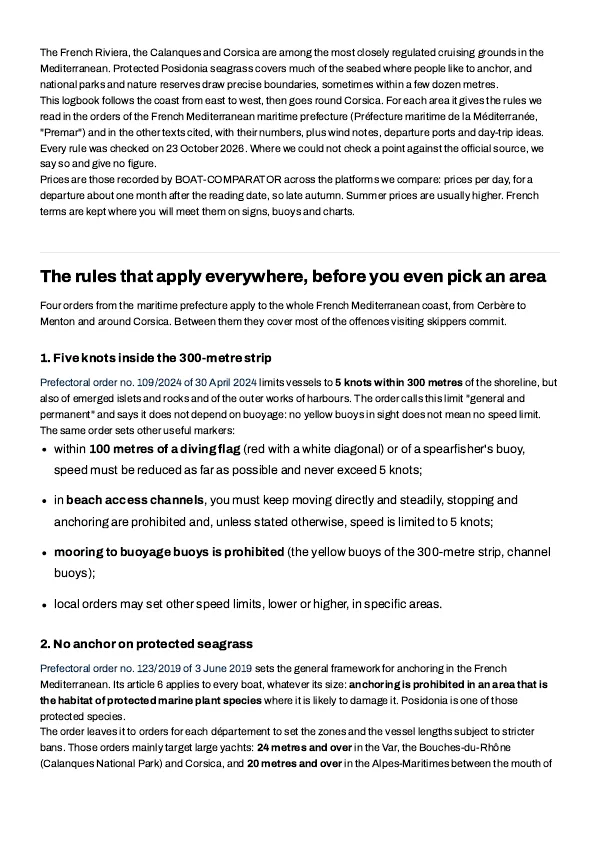
Four orders from the maritime prefecture apply to the whole French Mediterranean coast, from Cerbère to Menton and around Corsica. Between them they cover most of the offences visiting skippers commit.
1. Five knots inside the 300-metre strip
Prefectoral order no. 109/2024 of 30 April 2024 limits vessels to 5 knots within 300 metres of the shoreline, but also of emerged islets and rocks and of the outer works of harbours. The order calls this limit "general and permanent" and says it does not depend on buoyage: no yellow buoys in sight does not mean no speed limit.
The same order sets other useful markers:
- within 100 metres of a diving flag (red with a white diagonal) or of a spearfisher's buoy, speed must be reduced as far as possible and never exceed 5 knots;
- in beach access channels, you must keep moving directly and steadily, stopping and anchoring are prohibited and, unless stated otherwise, speed is limited to 5 knots;
- mooring to buoyage buoys is prohibited (the yellow buoys of the 300-metre strip, channel buoys);
- local orders may set other speed limits, lower or higher, in specific areas.
2. No anchor on protected seagrass
Prefectoral order no. 123/2019 of 3 June 2019 sets the general framework for anchoring in the French Mediterranean. Its article 6 applies to every boat, whatever its size: anchoring is prohibited in an area that is the habitat of protected marine plant species where it is likely to damage it. Posidonia is one of those protected species.
The order leaves it to orders for each département to set the zones and the vessel lengths subject to stricter bans. Those orders mainly target large yachts: 24 metres and over in the Var, the Bouches-du-Rhône (Calanques National Park) and Corsica, and 20 metres and over in the Alpes-Maritimes between the mouth of the Var and the Italian border. For a hired boat of 6 to 15 metres, the working rule remains article 6, plus the local zones described in the following chapters.
The order also states two simple points: anchoring is prohibited in harbour approach channels and in beach buoyage channels, and a boat at anchor must be reachable at all times by VHF, or failing that by phone, by the signal station (sémaphore) or the CROSS.
3. Seventy-two hours in one spot, no more
Prefectoral order no. 77/2025 of 15 April 2025 limits how long you may stay at anchor. A boat that does not need an anchoring authorisation may stay 72 hours in the same place. After that, a vessel under 24 metres that has no AIS must leave as soon as the weather allows and may not come straight back within a 500-metre circle around its first position. The order does not apply inside harbours.
4. Reading the zone codes on buoyage plans
Every coastal commune has a buoyage plan for its 300-metre strip, set by an order of the maritime prefect. Order 109/2024 and these plans use the codes you will meet throughout this logbook:
| Code | French name | What it means for you |
|---|---|---|
| ZIEM | Zone interdite aux embarcations motorisées ou à moteur | No navigation and no anchoring for any boat with an engine, even switched off, nor for a motorised tender |
| ZIM | Zone interdite au mouillage | No anchoring, whatever the type of anchor |
| ZMA | Zone de mouillage autorisée | Anchoring allowed, often below a length limit |
| ZMP | Zone de mouillage propre | Reserved for boats fitted with black-water holding tanks |
| ZMEL | Zone de mouillages et d'équipements légers | Organised mooring buoys, usually run by the commune, with their own by-laws |
| ZRUB | Zone réservée uniquement à la baignade | Swimmers only, no boats |
In a ZIEM, the ban also covers a sailing yacht with an engine, even if the engine is off: order 109/2024 says so explicitly.
What these rules do not tell you
They do not tell you where the seagrass is under your hull. Checking that is the skipper's job: in clear water, aim for clean sand, prefer an organised buoy where there is one, and follow the charter company's instructions. Our guides to anchoring properly and anchorage etiquette and to how much chain to let out cover the technique.
End of the free preview. Chapters 2 to 12 continue in the full guide.
Secure payment by StripeApple PayGoogle PayInstant PDF + online access
- Format: PDF to download and print, plus an online page you can read on your phone
- 12 chapters, 28 A4 pages, over 5,500 words · updated 23 October 2026
- Full refund on request within 14 days (terms of sale)
How it works
- You pay on Stripe’s secure page: card, Apple Pay, Google Pay or Link. One payment of €29, no subscription, no account.
- You land straight on your guide: read it online and download the PDF. The link is also emailed to you with the receipt.
- Lost the link? “Find my purchases” emails it to you again. Any question: admin@tech-bharat.com.
Questions before you buy
Are the rules up to date?
Every rule was checked in the official texts listed in the last chapter, on the date shown (updated 23 October 2026). When a text changes, the guide is updated and your link always shows the latest version. The rental company’s instructions, the harbour office and the day’s notices to mariners always come first.
Where do the prices come from?
From BOAT-COMPARATOR’s automatic readings on the platforms we compare, dated in each table. They are not quotes: the price of your rental is the one the platform shows when you book.
Does the guide replace a licence or training?
No. It helps you rent, prepare and ask the right questions; it does not replace training, a licence where one is required, or the rental company’s briefing.
Can I get a refund?
Yes: write to admin@tech-bharat.com within 14 days of your purchase and we refund you in full, no questions asked.
Who sells the guide?
The site is published by Lacangel Group SAS (Paris, France; publication director Clément Lacaille), which also sells the guides; payment is handled by Stripe. Not available to consumers resident in the United Kingdom. Details in the terms of sale.
The other guides
-
The Skipper’s Pack: all 5 guides and the logbook
Everything you need to rent a boat with confidence, from the first quote to the return to port: rules, contract, sailing areas, charter, and a printable logbook.
-
No-Licence Boat Hire in the Mediterranean: What You Can Drive, Country by Country
France, Spain, Italy, Croatia and Greece: the real thresholds read in the official texts, Spain's October 2026 rule change, and a step-by-step method for your first outing.
-
Boat Rental in Croatia, Greece and the Balearics: Rules, Fees, Anchoring and Winds
Which licences are accepted, which taxes and park tickets apply, where you may not drop anchor and which winds to watch, checked against each country's official texts.
-
Sailboat and Catamaran Charter: Skippered or Bareboat, Budget, Crew and a Typical Week
Pick the charter format and the boat, cost the week line by line, organise the crew and follow four sample itineraries, with checked and dated rules.
-
Your First Boat Rental: Contract, Deposit, Insurance and Check-In Without Disputes
From reading the listing to getting your deposit back: fill-in sheets, checklists and a complaint letter template for renting in the Mediterranean.